
The experiment for viscosity for the Fluid Mechanics Laboratory. Scroll down for the procedure. Material to go with this video is as follows:
- Variation in Viscosity (instructor’s handout)
- Material on the viscometer used:
- BROOKFIELD DVE Digital Viscometer Operating Instructions Manual No. M15-356-B0916
- More Solutions to Sticky Problems. A very useful guide to the application of the viscometer, which may be very helpful in running the experiments and putting together the reports.
- Taking the Last Voyage with Newton and Pascal: The Life of Saint-Venant. His name is better known in mechanics of materials, but Saint-Venant was the first researcher (even before Stokes) to include viscosity in fluids on a theoretical basis. This will be important when we get to the wind tunnel test.
Procedure
Objectives
You are to determine the viscosity properties of at least three and no more than five fluids. Enough data (i.e. replicate testing) must be collected during the experiment to allow for basic statistical analysis of the data. You will need the Data Spreadsheet for Experiment to properly record and organise your data. Your objectives are:
- Determine whether each fluid is Newtonian or non-Newtonian; and
- Determine the dynamic viscosity of the fluids at room temperature, assuming it is Newtonian.
If data is readily available, your experimental findings should be comparable to reference viscosity values available in the literature, assuming your instructor has not assigned a “mystery fluid.” All of the fluids will be non-toxic.
Apparatus:
You will be using a Brookfield DVELV viscometer. The viscometer works by rotating a cylindrical piece (a spindle) in a beaker full of fluid. The rotation of the spindle generates shear in the fluid at a given velocity, which is a function of the rotational speed of the viscometer and the radius of the spindle. The torque which the viscometer must produce to maintain the speed of the rotation can be used to estimate the viscosity at a given rotational speed/shear rate.
The viscometer is shown below.

Although there are several spindles available for the viscometer, only four will be used with this experiment: s61, s62, s63 or s64. The main difference between the two is the length of the cylinder. Spindle 61 is considered a cylindrical spindle; Spindles 62 and 63 are disc spindles, and Spindle 64 is a reduced diameter spindle. The difference between them will be obvious on inspection, assuming the fluid is transparent. All spindles allow the use of the LV Guard Leg, which is useful in preventing damage to the spindle during operation. All spindles are calibrated for use with the guard leg; why is this important?
Procedure:
The viscometer will be used to measure the dynamic viscosity (µ) of several liquids at room temperature. A liquid is placed in a beaker, filled with at least 500 ml of fluid, and the spindle is immersed in the fluid. Your instructor has already assembled the viscometers, matched the spindle to the fluid, filled the beakers with fluids and immersed the spindles into the viscometer.
- The panel on the front of the viscometer is shown. Turn the viscometer on with the power switch in the center of the lower row on the panel. Make sure the motor is not rotating at this point.

- You will see the panel lit up in a similar way to what is shown below. There are several things which are indicated by the panel:
- Lower left-hand corner indicates if the motor is on or off (at this point it should be off.) If it is not, push the “Motor on/off” button shown above to do this. This also shows the rotational speed of the spindle in RPM.
- Lower center: percentage of maximum torque of the machine. For valid experimental data, this should neither exceed the machine’s capabilities nor drop below 10% of the machine’s torque capability.
- Lower right-hand corner: spindle number. The machine does not detect which spindle is mounted on the machine. You need to ensure that the spindle shown on the panel corresponds with the one in the viscometer. The best way to know is to inspect the connector between the spindle and the viscometer; it is engraved on the spindle side. For our purposes the easier way is to look at the spindle; the longer cylindrical spindle is s61, the shorter disc spindle is s62, the even smaller disc is s63, and the spindle where part of the shaft is smaller than the rest is s64. In any case record the spindle number.
- Upper center: the viscosity in centipoises. The viscometer makes the calculations from the torque and spindle readings and displays the viscosity during the test.
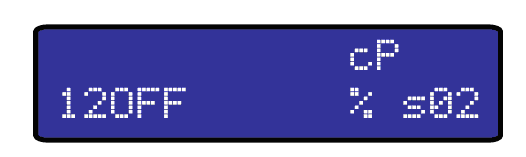
- Set the speed at around 12 RPM. This is done by varying the speed on the front panel.
- Start the motor. It takes the viscometer a few seconds (sometimes, more than a few seconds if the fluid is difficult) to obtain a reading. Wait until the reading stabilizes. You should get something like what is below. Assuming you have a valid reading (see above,) record a viscosity reading.

- Depending upon where in the torque range you find yourself, vary the torque one step at a time either up or down from this point. Which direction you go may depend upon the fluid; some fluids can be “fussy” in this regard. Ultimately, you’ll need to go both ways until you end up with a set of data points.
- Vary it upwards until the torque is either near or exceeds 100% of the machine’s maximum torque. Record a viscosity reading at each point. IMPORTANT NOTE: try to avoid getting all “EEEE” results as this will damage the machine in the long term. When you reach above 90%, take that reading and do not go further upwards in speed.
- Vary it downwards until it is near (but not below) 10% of the machine’s maximum torque. Record a viscosity reading at each point.
- When you have a complete set of data points, return the machine to 12 RPM and then stop the motor.
- Repeat this procedure for all the test liquids assigned.
Data Collection Format
The data collection format for the viscometer experiment is shown in the Data Spreadsheet for Experiment.
Video Data Collection
Video data collection is the same as physical data collection except that the different viscometer speeds are recorded as successive photographs. Note carefully the fluids used.
Data Reduction
For each fluid a plot of RPM (abscissa) vs. Viscosity (ordinate) should be constructed. A trend line should then be generated for each fluid reflecting the best fit.
At this point a determination should be made for each fluid as to whether it is Newtonian or non-Newtonian and, if the latter, pseudoplastic or dilatant. Both the instructor’s handout and video lectures explain how this is done. You need to use your best judgment to determine whether the fluid is Newtonian, pseudoplastic or dilatant. If you need additional guidance on this topic, you can consult the Brookfield publication entitled “More Solutions for Sticky Problems,” available on the instructor’s website.
One persistent mistake that you need to avoid is blindly using Excel’s plotting range for the y-axis. This will magnify differences in viscosity that may not be as meaningful as they look. You need to make sure that the origin of the plot is really at the origin, i.e. at the 0,0 point.
Report Writing
You need to make sure that, in your conclusion, you fulfill both objectives given at the start of this procedure. You should also be careful to present all your graphs and include reasons for your determinations in your analysis of the results.
 Chet Aero Marine