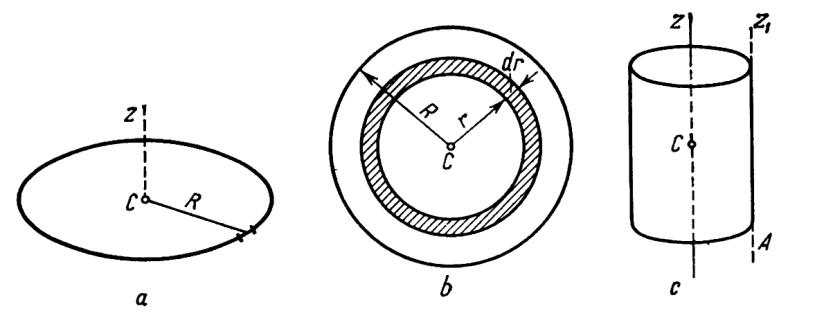
The mass moment of inertia of a cylinder with uniform thickness (square ends) is an elementary problem in engineering mechanics. But it’s also a good way of illustrating the relationship between the mass moment of inertia and the rotational moment of inertia, both of which are discussed in Two Papers on Vibratory and Impact-Vibration Hammers. There are two methods we can use: a) direct integration of the volume/mass and b) area rotational moment of inertia which can, under certain circumstances, can be used to determine the mass moment of inertia.
Direct Integration of the Volume/Mass
A diagram of the cylinder is shown above, from Targ (1988). We start with the integration formula thus, using (b) in the diagram above for the entire volume (c):

Integrating,

Note that, in this form, it is unnecessary to compute the mass of the cylinder before the mass moment of inertia.
Using the Area Rotational Moment of Inertia
The integral formula for just the circular area (a) in the diagram above is given using the formula

If we compare this with Equation (1), we note the similarity. In fact, if a) the density 


For the very specific conditions given above, either from dividing Equations (1) and (3) or Equations (2) and (4),

As is the case in this post, composite areas are volumes are used to compute the mass moment of inertia. If the conditions are as noted above, area moments of inertia (which are more commonly tabulated) can be used to compute mass moments of inertia.
 Chet Aero Marine