To Download This Book Click Here
About the Book
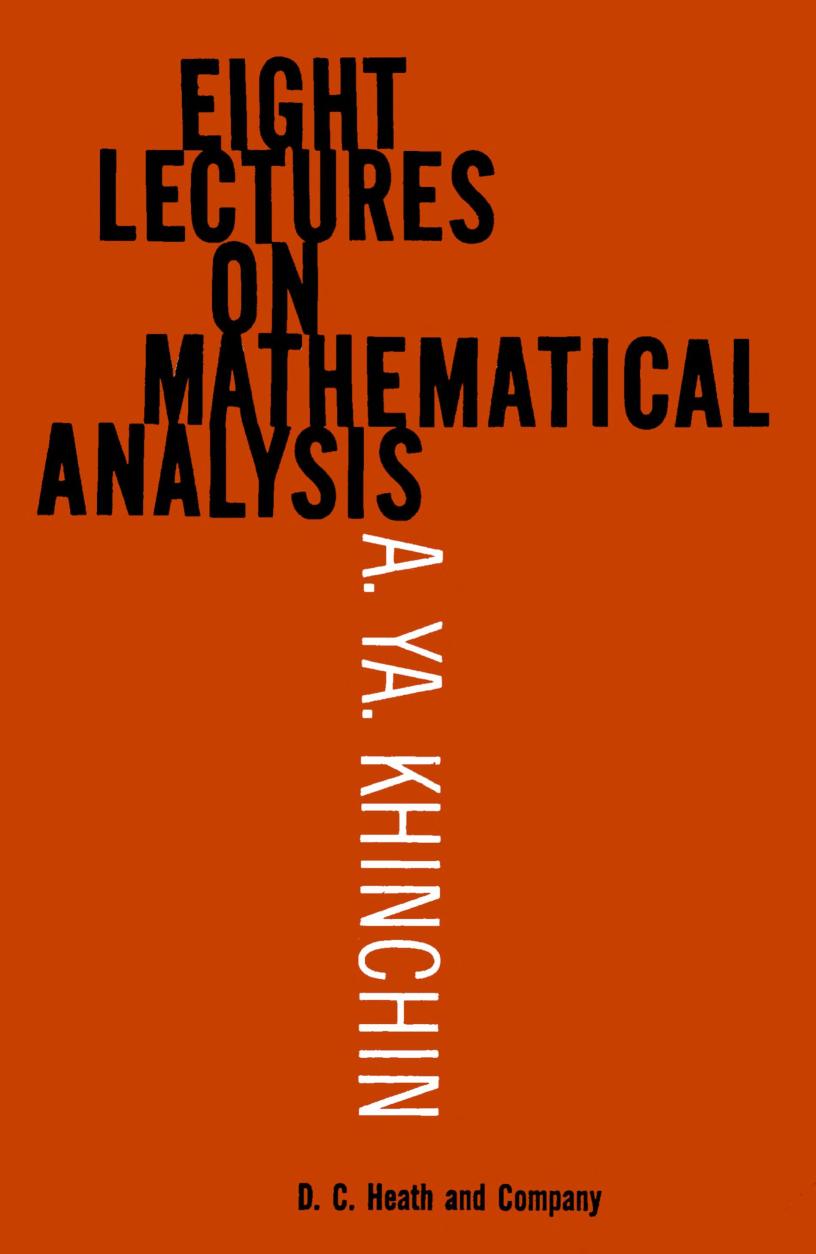
Eight Lectures on Mathematical Analysis is a translation and adaptation of a book by the outstanding Russian mathematician A. Ya. Khinchin. It is based on a series of lectures delivered at the University of Moscow by Professor Khinchin to improve the mathematical qualifications of engineers.
In this book, the reader will find a masterful outline of the fundamental ideas of mathematical analysis. Inessential details have purposely been omitted, and the resulting exposition is clear and easy to follow. The book should be accessible to anyone who has had even a sketchy introduction to the material. And yet, because it is a concise, lucid exposition of the most important concepts of mathematical analysis, the book should be of value to the student enrolled in a university course in analysis.
A. YA. KHINCHIN, until his death in 1959, was a professor at Moscow State University, a corresponding member of the Academy of Sciences, and a member of the Academy of Pedagogical Sciences of the RSFSR. The author of more than one hundred fifty mathematical research papers and books, he will be remembered as a world-renowned authority in mathematical analysis, probability theory, number theory, and mathematical statistics.
Table of Contents
LECTURE 1. The Continuum 1
- Why begin with the continuum? 1
- Need for a theory of real numbers 3
- Construction of the irrational numbers 7
- Theory of the continuum 11
- Fundamental lemmas of the real number system 16
LECTURE 2. Limits 22
- What is a limit? 22
- Some ways of tending toward a limit 24
- The limit of a constant function 27
- Infinitely small and infinitely large quantities 28
- Cauchy’s condition for the limit of a function 31
- A remark on the fundamental theorems on limits 33
- Partial limits; the upper and lower limits 33
- Limits of functions of several variables 40
LECTURE 3. Functions 44
- What is a function? 44
- The domain of a function 49
- Continuity of a function 50
- Bounded functions 52
- Basic properties of continuous functions 55
- Continuity of the elementary functions 60
- Oscillation of a function at a point 63
- Points of discontinuity 65
- Monotonic functions 67
- Functions of bounded variation 69
LECTURE 4. Series 71
- Convergence and the sum of a series 71
- Cauchy’s condition for convergence 74
- Series with positive terms 75
- Absolute and conditional convergence 81
- Infinite products 84
- Series of functions 88
- Power Series 96
LECTURE 5. The Derivative 102
- The derivative and derivates 102
- The differential 108
- Lagrange’s theorem (first mean value theorem) 113
- Derivatives and differentials of higher order 116
- Limits of ratios of infinitely small and infinitely large quantities 118
- Taylor’s formula 121
- Maxima and minima 125
- Partial derivatives 127
- Differentiating implicit functions 132
LECTURE 6. The Integral 137
- Introduction 137
- Definition of the integral 138
- Criteria for integrability 144
- Geometric and physical applications 148
- Relation of integration to differentiation 152
- Mean value theorems for integrals 154
- Improper integrals 158
- Double integrals 164
- Evaluation of double integrals 169
- The general operation of integration 173
LECTURE 7. Expansion of functions in series 177
- Use of series in the study of functions 177
- Expansion in power series 179
- Series of polynomials and the Weierstrass theorem 183
- Trigonometric series 190
- Fourier coefficients 192
- Approximation in the mean 194
- Completeness of the system of trigonometric functions 197
- Convergence of Fourier series for functions with a bounded integrable derivative 201
- Extension to arbitrary intervals 203
LECTURE 8. Differential Equations 206
- Fundamental concepts 206
- The existence of a solution 211
- Uniqueness of the solution 220
- Dependence of the solution on parameters 222
- Change of variables 226
- Systems of equations of higher orders 230
 Chet Aero Marine