This is a fairly straightforward (if a little computationally intensive) solution of the resultant of five concurrent, three-dimensional static forces. The problem is from Seely and Ensign but is done with vector notation, which is a little more complicated but requires less “originality” in the solution.
The problem is as follows:
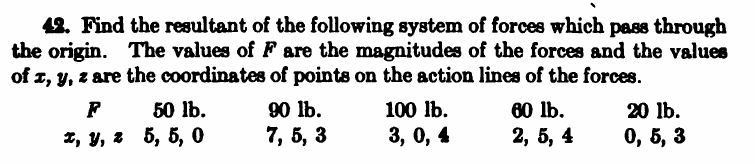
The first thing we do is to find the unit vectors of each of the forces, which are collinear with the position vectors implied above. The position vectors, formally stated, are as follows:
- r1 = 5i + 5j
- r2 = 7i + 5j + 3k
- r3 = 3i + 4k
- r4 = 2i + 5j + 4k
- r5 = 5j + 3k
After that we compute the scalar magnitude of the position vectors, which are as follows:
- R1 = (52 + 52)1/2 = 501/2
- R2 = (72 + 52 + 32)1/2 = 831/2
- R3 = (32 + 42)1/2 = 5
- R4 = (22 + 52 + 42)1/2 = 451/2
- R5 = (52 + 32)1/2 = 341/2
Then we divide the position vectors by the position scalar magnitudes to come up with the unit vectors:
- u1 = (5i + 5j)/501/2 = 0.7071i + 0.7071j
- u2 = (7i + 5j + 3k)/831/2 = 0.7683i + 0.5488j + 0.3293k
- u3 = (3i + 4k)/5 = 0.6i + 0.8k
- u4 = (2i + 5j + 4k)/451/2 = 0.2981i + 0.7453j + 0.5962k
- u5 = (5j + 3k)/341/2 = 0.8574j + 0.5145k
After these things (μετά ταύτα) multiply the scalar magnitudes of the forces with the unit vectors to obtain the vector values of the forces:
- F1 = 50(0.7071i + 0.7071j) = 35.4i + 35.4j
- F2 = 90(0.7683i + 0.5488j + 0.3293k) = 69.2i + 49.3j + 29.6k
- F3 = 100(0.6i + 0.8k) = 60i + 80k
- F4 = 60(0.2981i + 0.7453j + 0.5962k) = 17.9i + 44.7j + 35.8k
- F5 = 20(0.8574j + 0.5145k) = 17.1j + 10.3k
Finally we add the forces together coordinate by coordinate to obtain the following, which is the resultant of the concurrent forces
F1+2+3+4+5 = (35.4+69.2+60+17.9)i + (35.4+49.3+44.7+17.1)j + (29.6+80+35.8+10.3)k = 182.5i + 146.5j + 155.7k
We also would like to determine the direction cosines of the resultant. This is done by determining the unit vector of the resultant and taking the arc-cosines of the coefficients.
- The resultant is: F1+2+3+4+5 = 182.5i + 146.5j + 155.7k
- The scalar magnitude: F = (182.52 + 146.52 + 155.72)1/2 = 281 lbs.
- The unit vector is thus u1+2+3+4+5 = (182.5i + 146.5j + 155.7k)/281 = 0.6489i + 0.5216j + 0.5539k
The coefficients of the unit vector are the direction cosines, we take the arc-cosine of each to determine the angles:

- α = θx = 49.5416 deg.
- β = θy = 58.5589 deg.
- γ = θz = 56.3626 deg.
The angles are illustrated in the diagram at the right.
The sequence is a little involved; we have a spreadsheet which makes the calculations a little simpler, clearer and reduces the transmission of numerical round-off.
 Chet Aero Marine