This is an example of three-dimensional equilibrium using couples. The problem comes from Theoretical Mechanics – A Short Course -Targ.
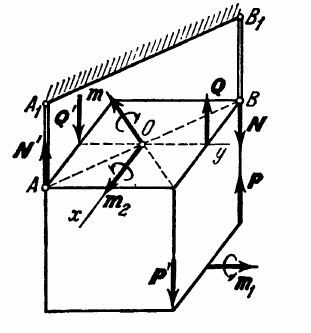
Consider the cube at the right, and the following conditions:
- Force pair P and P’ produce couple m1
- Force pair Q and Q’ produce couple m2
- Force pair N and N’ produce couple m
- Coordinates x and y shown, z is upward from O
- Neglect weight of cube (sides are equal, length a)
Find values of P and Q so that system is in equilibrium, and Value of N (reactions.)
We proceed as follows:
- Vectors for moments:
- m1 = m1 j
- m2 = m2 i
- m = -.7071 i – .7071 j
- Summing moments:
- X-direction = m2 – .7071 m = 0
- Y-direction = m1 – .7071 m = 0
- We can see from the above that both m1 and m2 are both equal to .7071 m, and are thus equal to each other
- Since m1 = P a and m2 = Q a, P and Q are equal to each other for equilibrium
- Substituting x-direction results, Q a = .7071 m
- From the geometry, m = 1.414 a N
- Substituting, Q a = P a = N a and thus Q = P = N
 Chet Aero Marine